

Catalytic pyrolysis
Pyrolysis is a thermal decomposition process carried out in an inert atmosphere (without oxygen). Under the influence of temperature (generally between 300 and 800°C), polymers break down into products in three distinct phases, gaseous, liquid and solid, which can be valuable to the chemical and energy industries. This technique is a suitable recycling solution for the treatment of polymer waste (plastics, rubber, resins, etc.) and polymer-based composites that cannot be processed by conventional mechanical recycling.
Depending on the experimental parameters and the use of a catalyst, it is possible to adjust the selectivity of the products obtained. Indeed, unlike simple thermal pyrolysis, which often produces heavy waxes (carbon number C > 20), the use of catalysts can enable the production of lighter molecules (C < 12), which are more easily utilised. In particular, in certain cases it is possible to obtain higher fractions of aromatic hydrocarbons such as benzene, toluene or xylenes, which are molecules that can be used for the synthesis of solvents or new materials such as polyurethane.
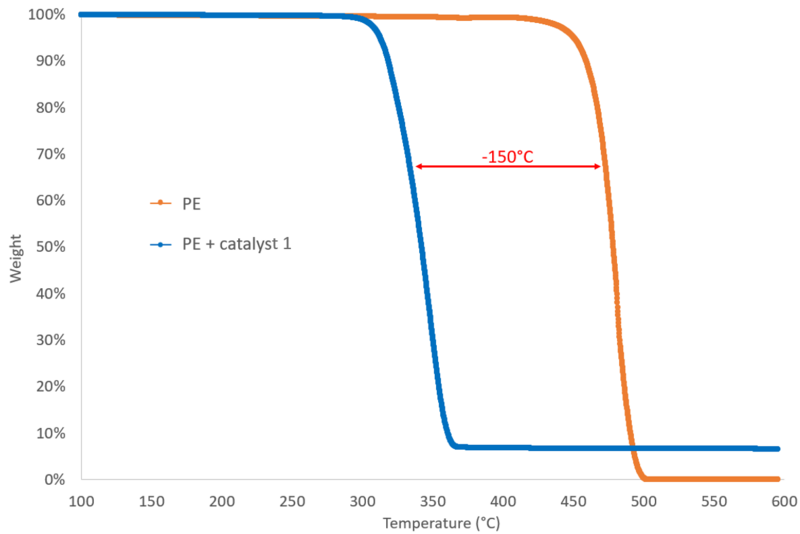
Certain catalysts can also help to reduce the pyrolysis temperature, thereby improving the energy efficiency of the process.

Regarding catalysts, POLYREC relies on the knowledge acquired in recent projects, and works also with the academic laboratory UCCS (Unity of Catalysis and Chemistry of the Solid) on certain projects.
We currently have several experimental set-ups for this process:
We have two stainless steel vessels (Tmax 600°C) with volumes of 25 & 200mL. These instruments can be charged up to 80% of their volume, giving more consistent results.

Tubular pyrolysis reactor in borosilicate (Tmax 500°C) or quartz (Tmax 1000°C). The tubular shape of this reactor allows continuous flow of inert gas over the sample.

Flash pyrolysis tubular reactor (Tmax 800°C). In addition to continuous gas flow, this reactor enables higher temperatures to be reached and reactions to be carried out in flash mode. Indeed, it is designed with a cold chamber at the tip for rapid introduction of the sample into the reactor.

Fluidised bed reactor: This type of reactor, thanks to the constant agitation of the bed, provides a homogeneous distribution of heat and improves material/catalyst contact. It operates continuously with a regular supply of material, making it more flexible and better suited to the requirements of industrial processes.

Recent publications:
- Arango‐Ponton, P., Corjon, G., Dhainaut, J., Heymans, S., Duquesne, S., & Lamonier, J. (2024). Effect of the nature, the content and the preparation method of Zeolite‐Polymer mixtures on the pyrolysis of linear Low‐Density polyethylene. Advanced Energy and Sustainability Research, 5(9). https://doi.org/10.1002/aesr.202400072
- Klaimy, S., Lamonier, J., Casetta, M., Heymans, S., & Duquesne, S. (2021). Recycling of plastic waste using flash pyrolysis – Effect of mixture composition. Polymer Degradation and Stability, 187, 109540. https://doi.org/10.1016/j.polymdegradstab.2021.109540
- Klaimy, S., Ciotonea, C., Dhainaut, J., Royer, S., Casetta, M., Duquesne, S., Tricot, G., & Lamonier, J. (2019). Flash Catalytic Pyrolysis of Polyethylene over (Alumino)silicate Materials. ChemCatChem, 12(4), 1109–1116. https://doi.org/10.1002/cctc.201901819
In addition to the experimental set-ups already in place, our team regularly develops and invests in new set-ups and instruments to meet specific needs.
So do not hesitate to contact us to discuss your specific requirements.