

Supercritical CO2 (scCO2) depollution
Supercritical carbon dioxide (scCO2) is a fluid with interesting properties, lying between those of a gas and a liquid. Indeed, by adjusting the temperature and pressure beyond its critical point (31.1°C and 73.8 bar), the fluid acquires high diffusivity, enabling it to penetrate within certain solid materials, whilst retaining sufficient solvent power to dissolve specific compounds.
This dual capacity eneables these compounds to be extracted whilst minimising the alteration of the mechanical structure of the treated materials. Furthermore, the use of supercritical CO2 offers operational and environmental benefits because, unlike conventional organic solvents, it is non-toxic, non-flammable and leaves no residue on the final material.
On an industrial scale, scCO2 has been used since the 1980s for coffee decaffeination and the extraction of essential oils or natural flavourings.
This technology is now being applied to polymer recycling, particularly for decontamination. Indeed, scCO2 causes the polymer matrix to swell, thereby facilitating the migration and extraction of impurities such as residual monomers, additives, oligomers or organic pollutants. This process yields purified polymers whose technical properties are similar to those of virgin material, thereby promoting their recycling.
scCO2 and its swelling property can also be used to disassemble complex composites (multi-layered materials, fibre-reinforced materials, photovoltaic panels, footwear, etc.).
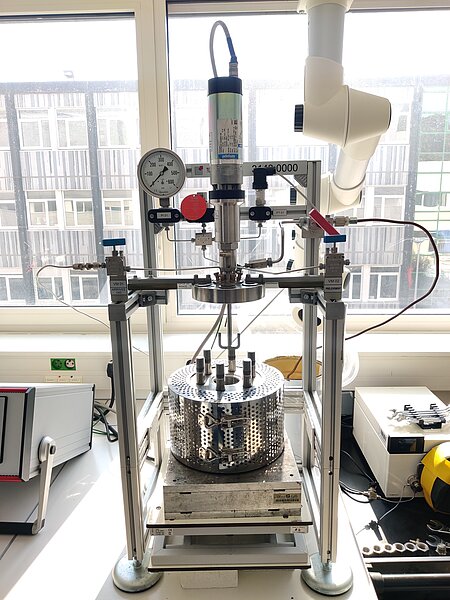
At POLYREC, we are currently using this fluid in two experimental set-ups:
This instrument ensures that the sample remains in contact with the same volume of scCO2 throughout the experiment. In addition, a stirrer enables uniform contact between the sample and the scCO2.
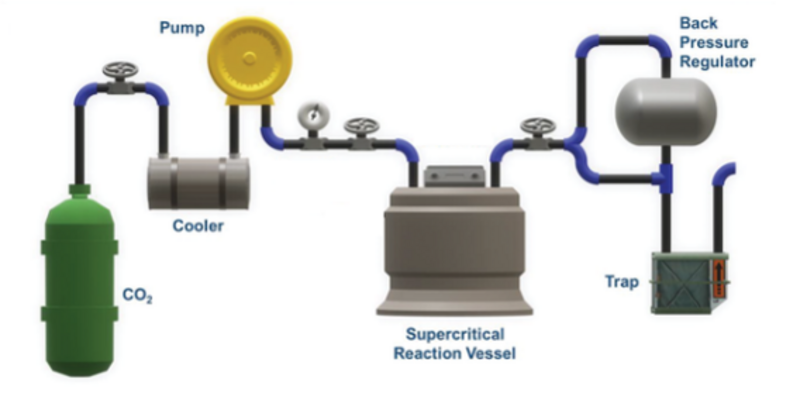

* Adapted from https://doi.org/10.1002/adfm.202104135
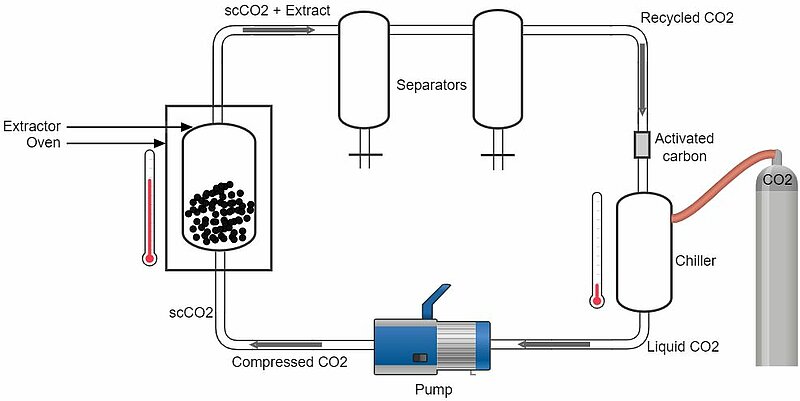
This instrument enables a continuous flow of scCO2 to pass through the sample during the experiment. As it passes through the sample, the scCO2 flow extracts the contaminants, which are removed from the cell and collected in the separators. At the outlet of the separators, the CO2 is filtered and then reinjected into the flow to minimise the need of additional CO2.
This equipment also allows the use of co-solvents when necessary.


In addition to the experimental set-ups already in place, our team regularly develops and invests in new set-ups and instruments to meet specific needs.
So do not hesitate to contact us to discuss your specific requirements.